
Beyond "Good Enough": The Essential Guide to Implementing Change in a Scale-Up
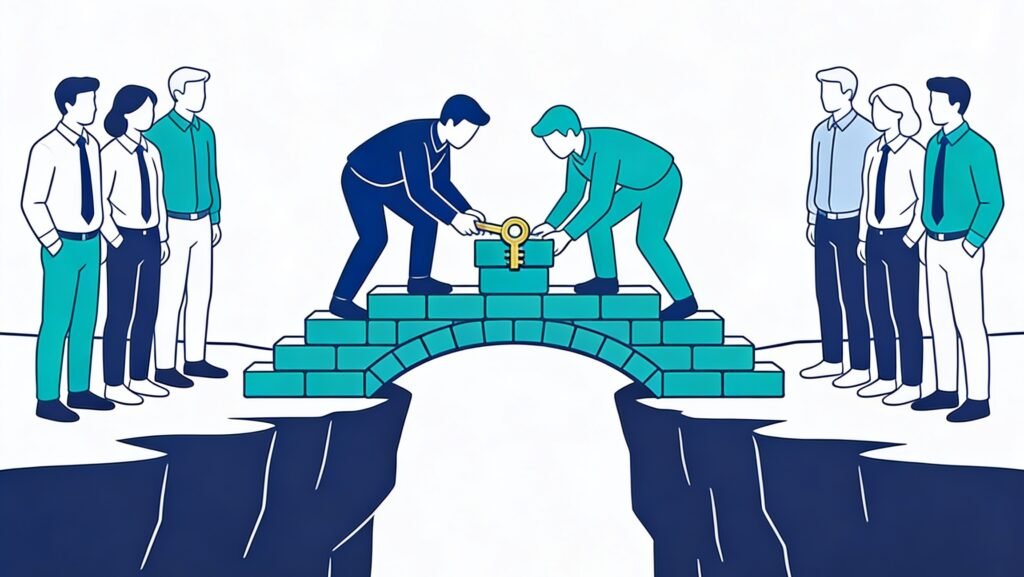
Executive Summary: The 1-Minute Read
- The Problem: Newly hired “Scalers” identify “no-brainer” improvements (like new CRMs or financial controls) but hit a wall of subtle resistance from your loyal “Pioneer” team. Progress stalls, and simple fixes get bogged down in what looks like stubbornness.
- The Diagnosis: You are facing the “No-Brainer Paradox.” When implementing change your Pioneers aren’t being insubordinate; they are protecting the company’s “soul.” They view these new processes as a direct threat to the agility and identity they built, fearing the business is becoming the slow, corporate bureaucracy they originally escaped.
- The Solution (Phase 1): Stop trying to “boil the ocean” with revolutionary change. Adopt the “Micro-Win Strategy” by identifying a specific pain point that hurts the team (not just management) and co-opting a vocal resistor to help design the fix.
- The Evolution (Phase 2): Evangelise the victory. Publicly credit both the Pioneer’s insight and the Scaler’s expertise for the win. This proves that process improves work rather than adding red tape, turning resistance into curiosity and making the wider transformation a voluntary, shared journey.
Your business is succeeding. You’ve found product-market fit, built a passionate team, and navigated the chaotic startup waters to reach a level of success most founders only dream of. You’re a “flourishing” business. But you’re ambitious. You see the next level – the path from a successful small business to a true market leader – and you know that “good enough” is no longer good enough. The challenge of implementing change in a scale-up is not knowing what to do, but how to do it.
You see opportunities to accelerate, so you’ve brought in new, experienced hires, just as we discussed in the last article. They arrive, and within weeks, they’ve identified a dozen “no-brainer” changes. A new CRM is needed. The financial reporting is a mess. The marketing process is entirely ad-hoc. They are ready to execute.
And then they hit a wall.
It’s not a wall of open defiance, but one of subtle, frustrating resistance. The existing staff – your loyal “pioneers” – seem to drag their feet. Processes that should be simple get bogged down. You hear whispers of “That’s not how we do things here” or “This seems like corporate bureaucracy.”
This is one of the most common and dangerous phases in a scale-up’s journey. As someone who has guided numerous businesses through this exact transition, I want to assure you: this is normal. But navigating it requires a strategic mindset that is often counter-intuitive to a hard-charging founder.
The "No-Brainer" Paradox: Why Employees Resist Change in Scale-Ups
To you and your new “scaler” hires, the changes are obvious. A proper CRM will increase sales. Better financial controls will improve cash flow. A strategic marketing plan will build a predictable pipeline. These are objective facts. Yet, McKinsey’s research is blunt: when organisations launch transformations, roughly 70 percent fail – usually because leaders don’t build conviction, capability, and buy‑in early enough. So why the resistance?
You have to understand the psychology of your existing team.
First, it’s not resistance; it’s protection. Your pioneer team is the group that built this success from nothing. They created the “scrappy” processes that got you here. When a new hire arrives and immediately wants to “fix” that process, what the pioneer hears is, “The work you’ve been doing for three years is wrong.” It feels like a direct critique of their effort and ingenuity. They aren’t just protecting a process; they are protecting their legacy and the company’s “soul.”
Second, they fear the loss of identity and speed. Startups thrive on autonomy and agility. Your early team is used to “just getting it done.” The introduction of new systems, new meetings, and new layers of approval, while necessary for scale, feels like the end of the very culture they love. They fear becoming the slow, bureaucratic corporation they may have left to join you in the first place.
Understanding this perspective is the first step. You’re not dealing with insubordination; you’re dealing with a human reaction to a perceived threat.
Evolution, Not Revolution: The True Timeline of Change
Your new Operations Lead maps out a plan to implement a new financial system. “I can get this done in six months,” they declare. You’re thrilled.
A year later, the system is only partially adopted, the team is frustrated, and you’re still relying on the old spreadsheets.
What went wrong? The “Scaler’s Dilemma” is underestimating the human element. You’re not just installing software; you’re changing a dozen deeply ingrained daily habits across every department. In a scale-up, what one person thinks can be fixed in a few months often takes a couple of years to truly and incrementally change.
Trying to force rapid, revolutionary change is like trying to turn a speedboat into a cruise liner overnight. You’ll just sink the boat. This journey is one of evolution not revolution. You have to accept that deep, foundational change – the kind that truly scales a business – is a slow, deliberate process of laying one brick at a time. If you try to rush it, the entire structure will be unstable.
The "Micro-Win" Strategy: How to Build Unstoppable Momentum
So, if you can’t force it, how do you make progress? The answer is to stop trying to doing too much too soon. Look for “micro-wins” instead to implement change.
A micro-win is a small, visible, and deeply felt improvement that demonstrates the value of the new approach. This strategy is your single most effective tool for overcoming resistance.
Here’s how to execute it:
- Identify a Genuine Pain Point (Not Your Pain Point): Don’t start with the change you want most (e.g., a new board reporting package). Start with a change the team needs. Listen for their frustrations. Is someone on the finance team spending two days a month manually reconciling invoices? Is the sales team constantly asking, “Do we have any new case studies?” Find a small, persistent problem that genuinely makes their lives harder.
- Co-Opt a Resistor: Identify the person who is most vocal about the “old way” of doing things but is also directly affected by this pain point. Go to them and say, “I know this process is a nightmare for you. Our new marketing lead and I have an idea for how we could automate it. Would you be willing to help us design it so it actually works for you?” By making them part of the solution, you’ve converted a potential blocker into an ally.
- Execute Flawlessly and Deliver the Win: This is not a “skunkworks” project. This is a top-priority, 30-day sprint. Get it done. Fix the problem. Automate the report. Create the new sales asset library.
- Evangelize the Victory: This is the most important step. Announce the win to the entire company. But don’t frame it as, “The new ops team fixed the old, broken process.” Frame it as, “Thanks to Pioneer’s Name’s incredible insights and New Hire’s Name’s expertise, we’ve managed to eliminate. This will save the team 10 hours a month.”
You’ve just done four crucial things:
- You solved a real problem.
- You showed the value of the new hire’s expertise.
- You gave public credit to a pioneer, reinforcing their value.
- You demonstrated that new processes aren’t about bureaucracy; they’re about making work better.
One or two of these micro-wins, and the entire narrative changes. Resistance to implementing change turns into curiosity. “What else can we fix?” The team stops seeing change as a threat and starts seeing it as an opportunity.
This isn’t just a theoretical framework; it’s a practical, in-the-trenches tactic. I want to share a personal example of this micro-win strategy in action.
I once joined a business where the annual budget process was shockingly simple. The leaders of each part of the business simply put in their revenue and costs into a simple spreadsheet each year, which were then added up to form an overall budget for the company.
When I queried why they thought the revenue numbers were correct or what data underpinned their assumptions, the answer was, “This is what we think we’ll do. It’s what we’ve always done.” They genuinely didn’t understand why they should do anything different. Trying to implement change to a company-wide driver-based financial model was painful, as they didn’t see the point. It was obvious, however, that this “gut-feel” approach would shatter the moment the company hit a bumpy road.
To succeed at implementing change in a scale-up, I stopped trying to boil the ocean. Instead, I identified one open-minded leader within the organization (Step 2). We worked together to properly identify the drivers of their revenue movement—new customer acquisition, churn, average revenue per user, etc. (Step 3).
During the course of the year, the result was profound. That single leader was able to clearly explain why their revenue was either above or below the budget and what was driving performance, while none of the others could (Step 4).
The next year, I didn’t have to force anything. The other business leaders came to me wanting to change their approach to the budgeting process. We turned a massive, “painful” change into a voluntary one by proving its value on a small scale first. But, while its a journey that theoretically should have been completed in one budget process but it took over a year to implement the change.
Change is a Journey of Trust
As a CEO, your role in this phase is to be the chief translator and shock absorber. You must constantly translate the “why” from the 30,000-foot strategic level down to the on-the-ground reality. You must protect your pioneer team from feeling devalued while simultaneously empowering your new scalers to do the job you hired them for.
It’s a delicate balance. But by respecting the legacy of your existing team, playing the long game, and using strategic micro-wins to build trust, you can guide your company through this vital transition—not just preserving your culture, but evolving it to be stronger than ever.
Successfully implementing these changes does more than just improve efficiency—it buys you freedom. Once your team can execute without your constant intervention, your role must evolve.
Read my next insight on Why Your Most Important Job as a Founder is Making Yourself Redundant.